Thursday, June 25, 2009

Monday, April 20, 2009
Tuesday, March 11, 2008
This is Your Brain on Music: The Science of a Human Obsession
Lecture on his book This is Your Brain on Music by Daniel J. Levitin, Ph.D.
Associate Professor
James McGill Professor
Bell Chair in the Psychology of Electronic Communication
Laboratory for Music Perception, Cognition, and Expertise
Department of Psychology, McGill University

A fascinating exploration of the relationship between music and the mind—and the role of melodies in shaping our lives
Whether you load your iPod with Bach or Bono, music has a significant role in your life—even if you never realized it. Why does music evoke such powerful moods? The answers are at last becoming clear, thanks to revolutionary neuroscience and the emerging field of evolutionary psychology. Levitin unravels a host of mysteries that affect everything from pop culture to our understanding of human nature, including:
Are our musical preferences shaped in utero?
Is there a cutoff point for acquiring new tastes in music?
What do PET scans and MRIs reveal about the brain’s response to music?
Is musical pleasure different from other kinds of pleasure?
Levitin explores cultures in which singing is considered an essential human function, patients who have a rare disorder that prevents them from making sense of music, and scientists studying why two people may not have the same definition of pitch. At every turn, this provocative work unlocks deep secrets about how nature and nurture forge a uniquely human obsession.
Produced by:
Microsoft Research
September 12, 2006
http://ego.psych.mcgill.ca/levitin.html/
Dr. Daniel Levitin earned his B.A. in Cognitive Psychology and Cognitive Science at Stanford University, and went on to earn his Ph.D. in Psychology from the University of Oregon, researching complex auditory patterns and pattern processing in expert and non-expert populations. He completed post-doctoral training at Stanford University Medical School (in Neuroimaging) and at UC Berkeley (in Cognitive Psychology). He has consulted on audio sound source separation for the U.S. Navy, and on audio quality for several rock bands (including the Grateful Dead and Steely Dan), record labels, and served as one of the "Golden Ears" expert listeners in the original Dolby AC3 compression tests. He worked for two years at the Silicon Valley think tank Interval Research Corporation. He taught at Stanford University in the Department of Computer Science, the Program in Human-Computer Interaction, and the Departments of Psychology, Anthropology, Computer Music, and History of Science. Currently, he is an Associate Professor of Psychology, Behavioural Neuroscience, and Music at McGill University. He is the author of the forthcoming “This Is Your Brain On Music.”.
Lecture can be viewed at:
http://researchchannel.org/prog/displayevent.aspx?rID=6861&fID=345
Also:
Music and the Brain. The NewsHour with Jim Lehrer, segment with Daniel Levitin.
PBS, February 5, 2007. (PDF transcript)
Book:
From Publishers Weekly
Starred Review. Think of a song that resonates deep down in your being. Now imagine sitting down with someone who was there when the song was recorded and can tell you how that series of sounds was committed to tape, and who can also explain why that particular combination of rhythms, timbres and pitches has lodged in your memory, making your pulse race and your heart swell every time you hear it. Remarkably, Levitin does all this and more, interrogating the basic nature of hearing and of music making (this is likely the only book whose jacket sports blurbs from both Oliver Sacks and Stevie Wonder), without losing an affectionate appreciation for the songs he's reducing to neural impulses. Levitin is the ideal guide to this material: he enjoyed a successful career as a rock musician and studio producer before turning to cognitive neuroscience, earning a Ph.D. and becoming a top researcher into how our brains interpret music. Though the book starts off a little dryly (the first chapter is a crash course in music theory), Levitin's snappy prose and relaxed style quickly win one over and will leave readers thinking about the contents of their iPods in an entirely new way. (Aug.)
Copyright © Reed Business Information, a division of Reed Elsevier Inc. All rights reserved. --This text refers to the Hardcover edition.
From School Library Journal
Adult/High School–Levitin's fascination with the mystery of music and the study of why it affects us so deeply is at the heart of this book. In a real sense, the author is a rock 'n' roll doctor, and in that guise dissects our relationship with music. He points out that bone flutes are among the oldest of human artifacts to have been found and takes readers on a tour of our bio-history. In this textbook for those who don't like textbooks, he discusses neurobiology, neuropsychology, cognitive psychology, empirical philosophy, Gestalt psychology, memory theory, categorization theory, neurochemistry, and exemplar theory in relation to music theory and history in a manner that will draw in teens. A wonderful introduction to the science of one of the arts that make us human.–Will Marston, Berkeley Public Library, CA
Copyright © Reed Business Information, a division of Reed Elsevier Inc. All rights reserved. --This text refers to the Hardcover edition.
Friday, February 15, 2008
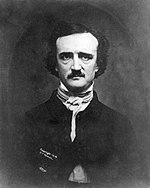
Edgar Allen Poe
Produced by:
Johns Hopkins University
October 26, 1958
Description:
This program, which originally aired on October 26, 1958, takes a close look at the life and work of Edgar Allen Poe. Though dated, the presentation is well done and entertaining.
Speaker(s):
John Astin, actor; visiting professor, School of Arts & Sciences, Johns Hopkins University
Link: http://www.researchchannel.org/prog/displayevent.aspx?rID=3428&fID=571
Runtime:00:33:38
Notes:
Edgar Allan Poe (January 19, 1809 – October 7, 1849) was an American poet, short-story writer, editor and literary critic
Writer
Best known for his tales of mystery and the macabre,
Poe was one of the earliest American practitioners of the short story
invented the detective-fiction genre.
He is credited with contributing to the emerging genre of science fiction.[1] He was the first well-known American writer to try to earn a living through writing alone, resulting in a financially difficult life and career.[2]
His most recurring themes deal with questions of death, including its physical signs, the effects of decomposition, concerns of premature burial, the reanimation of the dead, and mourning.
Had a theory of `single effect'-(depth) He advocated a prose tale (Poe's term for a short story) as a narrative that could be read at one sitting, from a half an hour up to two hours. He was adamant that such a story should be limited to "a certain unique or single effect" to which every other detail was subordinate. This concept emphasized unity of mood, time, space, and action working together to achieve the "certain unique or single effect."
Poe's ideal of the "certain unique or single effect," a short story has a succinct straightforward plot and characters that are disclosed in action and dramatic encounter rather than description and comment. In addition, by only including the number of characters and scenes necessary to the plot, concise narration and economy of setting are encouraged, therefore allowing the story to be communicated to the reader in its allotted time.
A typical plot of the literary short story begins near the climax and revolves around a character with a specific problem to solve. The plot climaxes when a recognizable change (for better or worse) occurs in the character or his/her situation as a direct result of having solved (or having failed to solve) the problem. Once the climax has been reached, the story quickly draws to a close.
As Critic
Critical of those with an inability to distinguish `obscurity of expression from expression of obscurity.
-(depth) Eschew obfuscation, also stated as: "eschew obfuscation, espouse elucidation", is a common humorous saying of English teachers and professors when lecturing about proper writing techniques.
Literally, the meaning is "avoid ambiguity, adopt clarity", but the use of relatively uncommon words in the English language itself causes confusion, making the phrase a prime example of irony. (depth) Irony is a literary or rhetorical device, in which there is an incongruity or discordance between what a speaker or a writer says; and what he or she means, or is generally understood.
He disliked didacticism[89] and allegory,[90] though he believed that meaning in literature should be an undercurrent just beneath the surface. Works with obvious meanings, he wrote, cease to be art.[91]
depth- didactic- The term "didactic" also refers to texts (and by extension, media, such as film or television) that are overburdened with instructive, factual, and/or otherwise "educational" information, sometimes to the detriment of a reader's (or viewer's) enjoyment. The opposite of "didactic" is "non-didactic." If a writer is more concerned with artistic qualities and techniques than with conveying a message, then that piece of work is considered to be non-didactic, even if it is instructive/educational.
Some have suggested that nearly all of the best poetry is didactic. Contrarily, Edgar Allan Poe called didacticism the worst of "heresies" in his essay The Poetic Principle.
Products:
Sunday, January 13, 2008
Steven Pinker "The Stuff of Thought."
Renowned linguist Steven Pinker speaks at Google's Mountain View, CA, headquarters about his book "The Stuff of Thought." This event took place on September 24, 2007, as part of the Authors@Google series. For more information about Steven Pinker, please visit http://pinker.wjh.harvard.edu/books/s...
Notes:
1.

2.

3.

4.

5.

6.

7.

8.

This references the story about how President Garfield died. After a botched assignation attempt where the bullet did not hit any organ nor major blood vessle- the President was treated to pathetic care and actually died of infection and starvation. The shooter objects to being charged with killing him- because in actuality the real causality was the doctors.
9.

10

11.

12.

13.

14.

15.

16.

17.

18.

19.

20.

21.

22.

23.

24.

25.

26.

27.

28.

29.

30.

31.

32.

33.

34.

35.

Saturday, January 5, 2008
Aubrey de Grey and his work at extending healthy life

Two talks by scientist Aubrey de Grey and his work at extending healthy life in humans to to a thousand years. My notes on his speeches, some of his slides and more information about Mr. de Grey.
Paul's notes Jan. 5 2008-
Key concept
1. metabolism ongoingly cases damage. Damage only eventually causes pathology. Pathology leads to death.
2. As humans we can try to prevent `damages' before they happen (prevention) and we can treat damages after we happen (medicinal intervention.)
3. Without the outrageous claims that a human can live to a thousand, de Gray's proposition that we should prevent pathologies that bring misery (and eventual death) is much less controversial.
4. In work on HIV, doctors first tried to help those afflicted cope. Then immediately they looked for cause (unsafe sex, transmission of contaminated blood, and re-use of contaminated needles- and began working to educate the populace to fight against the `pathology'.) Then as doctors witnessed how the HIV typically worked in breaking down the contaminated- they began working on ways to stop in advance the predictable pathologies, resulting with HIV sufferers living longer, healthier lives.
de Gray basically is doing the same thing withe issue of aging.
5. He gives a great car analogy, showing a jeep that has lasted well for fifty years because it was built like a tank. Then a VW bug that has lasted more than years because the owners liked it so much they kept it up, fixing whatever was wrong with it, and then he showed a vehicle in mint condition over 15o years old- also in excellent working order because the owners kept it up.
Its been said by others: People take better care of their cars (horses and dogs) then they do of themselves.
7. Slides


Definition of terms:
1. Pathology = pathology
"science of diseases," 1611, from Fr. pathologie, from Mod.L. pathologia, from Gk. pathologikos "treating of disease," from pathos "suffering" (see pathos) + -logia "study," from logos "word." Pathologist first recorded 1650. Pathological "pertaining to disease" formed in Eng. 1688;
a. the science or the study of the origin, nature, and course of diseases.
b. the conditions and processes of a disease.
c. any deviation from a healthy, normal, or efficient condition.
2. metabolism L
in physiology sense, 1878, from Fr. métabolisme, from Gk. metabole "change," from metaballein "to change," from meta- "over" + ballein "to throw." Metabolic is first attested 1845 in this sense, from Ger. metabolisch (1839). The word is attested from 1743 with the lit. sense of "involving change."
anabolic Look up anabolic at Dictionary.com
"pertaining to the process of building up (especially in metabolism)," 1876, from Gk. anabole "that which is thrown up, mound," from ana "up, upward" + ballein "to throw."
3. Gerontology gerontology
1903, coined in Eng. from Gk. geron (gen. gerontos) "old man," from PIE base *ger(e)- "to become ripe, grow old" (cf. Skt. jara "old age," Avestan zaurvan "old age," Ossetic zarond "old man"). the branch of science that deals with aging and the problems of aged persons.
4. geriatric
1909, formed in Eng. from Gk. geras "old age" (from PIE base *gere- "to grow old;" cf. Skt. jarati "makes frail, causes to age") + iatrikos "of a physician," from iatros, related to iasthai "heal, treat," of uncertain origin. Geriatrics was coined 1909 by Ignatz L. Nascher (1863-1944) in "New York Medical Journal" on the model of pediatrics. The correct formation would be gerontiatrics.
–adjective
a. of or pertaining to geriatrics, old age, or aged persons.
–noun
b. Slang. an old person.
Why you should listen to him:
A true maverick, Aubrey de Grey challenges the most basic assumption underlying the human condition -- that aging is inevitable. He argues instead that aging is a disease -- one that can be cured if it's approached as "an engineering problem." His plan calls for identifying all the components that cause human tissue to age, and designing remedies for each of them — forestalling disease and eventually pushing back death. He calls the approach Strategies for Engineered Negligible Senescence (SENS).
With his astonishingly long beard, wiry frame and penchant for bold and cutting proclamations, de Grey is a magnet for controversy. A computer scientist, self-taught biogerontologist and researcher, he has co-authored journal articles with some of the most respected scientists in the field.
But the scientific community doesn't know what to make of him. In July 2005, the MIT Technology Review challenged scientists to disprove de Grey's claims, offering a $20,000 prize (half the prize money was put up by de Grey's Methuselah Foundation) to any molecular biologist who could demonstrate that "SENS is so wrong that it is unworthy of learned debate." The challenge remains open; the judging panel includes TEDsters Craig Venter and Nathan Myhrvold. It seems that "SENS exists in a middle ground of yet-to-be-tested ideas that some people may find intriguing but which others are free to doubt," MIT's judges wrote. And while they "don't compel the assent of many knowledgeable scientists," they're also "not demonstrably wrong."
"Aubrey de Grey is a man of ideas, and he has set himself toward the goal of transforming the basis of what it means to be human."
MIT Technology Review
efeating aging: Aubrey de Grey's handbook – July 9, 2007
British biogerontologist, computer scientist and twice TED speaker Aubrey de Grey has just finished a book, "Ending Aging: The Rejuvenation Breakthroughs That Could Reverse Human Aging in Our Lifetime", where he details his controversial claim that "we could defeat aging".
Degreyendingagingcover Cheat sheet: Aubrey went on stage at TEDGLOBAL05 (video) and then at TED06 saying (I'm oversimplifying) that aging, like a disease, can be cured; that it is essentially a set of accumulating molecular and cellular transformations in our bodies, caused by metabolism, that eventually lead to pathology and kill us. Therefore, it could be approached "as an engineering problem": identify all the components of the variety of processes that cause tissues to age, and design remedies for each of them. He calls the approach "Strategies for Engineered Negligible Senescence" (SENS).
The book, co-written with his assistant Michael Rae, will be released September 4 by St Martin's Press. We e-mailed with Aubrey last week.
Aubrey, are you feeling older than last year?
Not really -- and that's despite the fact that my schedule has become even more punishing. I think the fulfilment I derive from spearheading the push to save so many lives somehow gives me the vitality to cope.
How has your research progressed since your TEDGLOBAL05 and TED06 speeches?
The Methuselah Foundation has gone from strength to strength. The biggest development, among other donations, was the pledge of $3.5m from TEDster and PayPal co-founder Peter Thiel, which resulted from a dialogue that began at TED. Most of his pledge ($3m of it) is a 1:2 challenge, so our current goal is to obtain $6m from elsewhere to match that pledge in full.
OK, that's about the funding. But how's the research going?
It's been going really well too. We are currently sponsoring research by three teams (in Phoenix, Houston and Cambridge UK) on two of the most important SENS strands -- LysoSENS, the identification and exploitation of microbial enzymes to break down molecules that we cannot naturally degrade, and MitoSENS, the incorporation of modified copies of the mitochondrial DNA into the chromosomal DNA so that mitochondrial mutations will have no effect. Both these projects are going really well, results coming out of the LysoSENS project have already been presented at two meetings and a paper has been submitted for publication in a prominent journal.
What should readers expect to learn from the book?
They will learn all about the detailed science of SENS. The book is written (largely by my splendid research assistant Michael Rae) very much for a non-scientist audience, but without dumbing down the science at all.
Thursday, January 3, 2008
Return to the Source - Philosophy and the Matrix
The Matrix is one of my favorite movies- took an immense amount oif noted on this- start with:
1. It is concerned with the superficiality of society
2. Similar to two Plato's allegory of the Cage - Descartes story of the evil deceivers.
4. Important quote: You are here because you know something, and what you know you cant explain, but you feel it.
5. Revelation comes in two ways a. God tells you b. a person figures it out on thier own.
5. The movie is a series of thought experiments
6. relationship with Phillip Dick (author0
7. is a tale in pyber punk- in which tends to have people turning into machines and machines turning into people ( Neo becomes one with the machine, the seemingly real woman who is the oracle is just a machine)
OUTSIDE NOTES
1. # This documentary is featured on disc 8 (The Roots of the Matrix)in The Ultimate Matrix DVD Collection, released in 2004.
2. Return to the Source: Philosophy & The Matrix - 61:04
To gain a real understanding of the Matrix Series, especially parts 2 and 3, one really must have at least some understanding of the philosophical and religious aspects of the story. Without this basic grounding, the last 2 films become a mish-mash of mumbo jumbo. This documentary goes a fair way towards explaining some of the philosophy behind the films. Here we have a wealth of philosophers and teachers that lend their thoughts and expertise to the viewer so that they may get a better understanding of what's behind the films.
Contributing here are:
Iakovos Vasiliou: Associate Professor of Philosophy, City University of New York, Graduate Center, Brooklyn College. (more notes from him here)
Ken Wilber, Writer and Philosopher. Mark Rowlands: Professor of Philosophy, University of Hartfordshire. John Searle: Professor of Philosophy, University of California, Berkeley. Christopher Graw: Associate Professor of Philosophy, Florida International University, Philosophy Editor of thematrix.com. T.J. Mawson: Philosopher, Oxford University. David Chalmers: Professor of Philosophy, Director of the Center for Consciousness Studies, University of Arizona. Colin McGinn: Author and Professor of Philosophy, Rutgers University. Dr. Cornel West: Author and Professor of Religion and African American Studies, Princeton University. Donna Bowman: Associate Professor of Religious Studies, The Honours College, University of Central Arkansas. Michael McKenna: Associate professor of Philosophy, Ithaca College. William Irwin: Professor of Philosophy, Kings College, Editor of "The Matrix and Philosophy". Richard Hanley: Professor of Philosophy, University of Delaware. Julia Driver: Professor of Philosophy, Dartmouth College. Rudy Rucker: Author. John Shirley: Author and Screenwriter. Bruce Sterling: Writer. Dr. Rachel Wagner: Hundere Teaching Fellow of Religion and Culture, Oregon State University. Christopher Vogler: Author. Frances Flannery-Dailey, Ph.D.: Author and Associate Professor of Religion, Hendrix College. Andy Clark: Philosopher and Cognitive Scientist, University of Edinburgh. Peter Chung: Director, Aeon Flux. Peter B. Lloyd: Software Consultant, Philosopher and Writer, Author of "Exegesis of The Matrix". John Partridge: Associate Professor of Philosophy, Wheaton College. Daniel Dennett: Author and Professor of Philosophy, Tufts University. Hubert Dreyfus: Author and Professor of Philosophy, University of California, Berkeley.
Subscribe to:
Posts (Atom)
